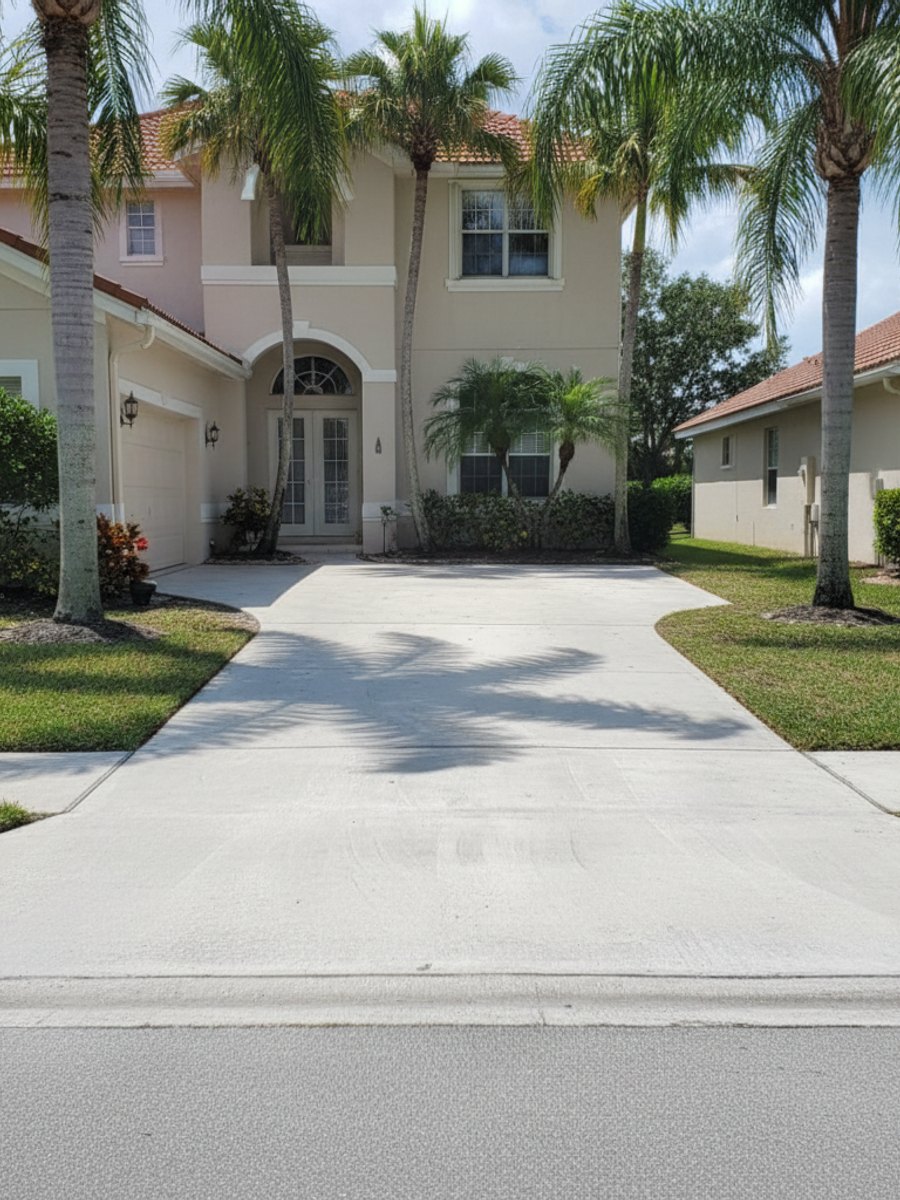
Port Orange sits on sandy soil close to the Halifax River and a network of drainage canals, and that changes how concrete work gets planned here compared to, say, Georgia clay country. Before you sign a contract or pick a finish, there are a handful of things worth checking yourself, or at least asking your contractor about directly.
1. What's actually in the ground. Most of Port Orange is sandy and drains fast, which is good news for a footing. But get within a few hundred feet of the river, a retention pond, or one of the older canal-fed neighborhoods and the water table can sit high enough to turn an excavation into a soupy mess after a summer storm. If your lot was part of old farmland or scrub before it was subdivided, there can be soft organic pockets a few feet down that need to be dug out and backfilled with compacted fill before anything gets poured on top.
2. Where the water goes when it rains hard. Port Orange gets heavy, fast afternoon thunderstorms from June through September, sometimes an inch in twenty minutes. A patio or driveway that's dead flat, or worse, sloped toward the house, will pond or send water into the garage. Concrete should pitch away from the foundation at roughly a quarter inch per foot. If your current slab already holds puddles after a storm, that's grading, not the concrete itself, and it's worth fixing before you repour on top of the same problem.
3. Tree roots, especially on older streets. Neighborhoods around Riverside Drive and the older sections near Dunlawton were mostly built in the 1950s through 70s, and a lot of those lots have big live oaks with roots running well under the driveway. Roots don't usually break a properly reinforced slab outright, but they can heave sections a half inch or more over a few years. Newer subdivisions off Taylor Road or Pioneer Trail don't have this problem yet, but their landscaping will in twenty years.
Who has to sign off before work starts
4. Permits. Concrete work inside Port Orange city limits goes through the City of Port Orange building division; if your property is technically unincorporated Volusia County, it's the county instead. Driveways, slabs, and pool decks generally need a permit and an inspection, though small patio pours and repairs sometimes don't, depending on size and location. A good contractor will know which side of that line your project falls on and pull the permit rather than leaving it to you.
5. Setbacks and your survey. Driveways in particular have to respect setback lines from the property boundary, and if you're widening one or adding a second pad, the inspector will want to see it doesn't encroach. If you don't have a copy of your survey, your county property appraiser's site usually has enough to at least confirm lot lines before anyone starts digging.
6. HOA approval. A lot of Port Orange, especially newer developments like Waters Edge and the Spruce Creek Fly-In community, has an active HOA with rules about color, finish, and sometimes even the contractor doing the work. This is separate from the city permit and it can take longer. Submit your plans to the HOA before you schedule the pour, not after.
What the Florida weather does to a pour
7. Timing around the rainy season. Fresh concrete needs at least a few hours of set time before rain can damage the surface, and a heavy downpour on a slab poured that morning can wash out the finish or leave pitting. Contractors around here watch the radar closely between June and September and will sometimes push a pour a day rather than gamble on an afternoon storm. That's not a delay tactic, it's the difference between a smooth surface and one that needs patching.
8. Heat and cure time. Florida summer heat speeds up the surface set faster than the concrete underneath, which can cause plastic shrinkage cracking if it isn't managed with curing compound or a wet cure. You can usually walk on a residential slab after about 24 to 48 hours, but it needs closer to seven days before you drive a car on it, and a full 28 days to reach its design strength. Anyone telling you to park on a driveway the next day is setting you up for tire marks and surface damage.
What's actually going into the slab
9. Thickness and reinforcement. A standard residential driveway runs 4 inches thick with either welded wire mesh or fiber mesh mixed into the concrete; if you're planning on parking a boat trailer or an RV on it, that should go to 5 or 6 inches with rebar on a tighter grid, not just mesh. Sidewalks and patios can usually stay at 4 inches. Ask what mix strength is being used, too. Most residential flatwork in this area runs 3,000 to 3,500 psi, but pool decks and driveways that'll see heavier loads or salt exposure do better at 4,000 psi.
10. Control joints. Concrete is going to crack somewhere as it shrinks while curing. Control joints are cut into the slab to decide where that crack happens instead of leaving it to chance. They're typically saw-cut within 24 hours of the pour, spaced at roughly two to three times the slab's thickness in feet, so a 4-inch driveway gets joints every 8 to 10 feet. If a contractor skips this step or spaces joints too far apart, you'll likely see a random crack running straight through the middle of a panel within a year or two.
If you're repairing instead of pouring new
One more thing worth checking, even though it's not strictly a pre-pour item: if you're resurfacing or patching an existing slab rather than starting fresh, get someone to look at whether the cracking is cosmetic or structural before you spend money on a cosmetic fix. A hairline crack that isn't moving is one thing. A crack with one side higher than the other, or one that's widening, usually means the base underneath has shifted, and resurfacing over that just hides the problem for a season or two.
None of this is complicated, but it's the kind of detail that gets skipped when a job is quoted fast and poured faster. If you want someone to walk your specific lot and tell you what the soil, drainage, and permit situation actually looks like before you commit to anything, that's the kind of groundwork PFL Concrete Co. does before a single yard of concrete gets ordered.